
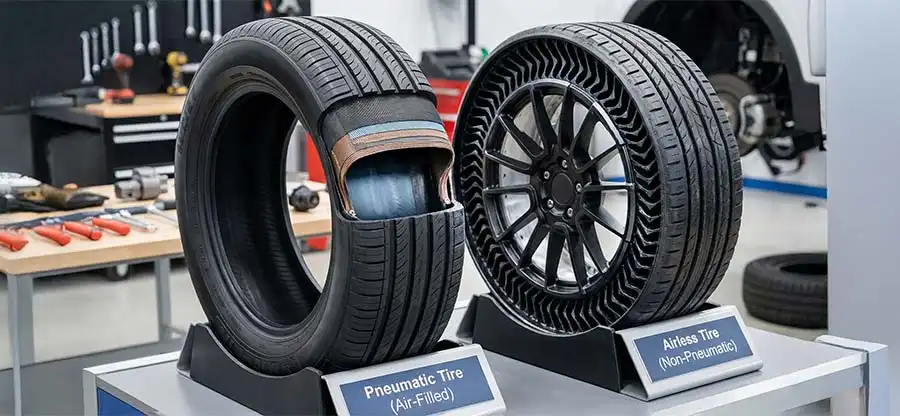
Few things feel as outdated as standing on the side of a highway in the rain, staring at a flat tire.
We drive electric cars with high-density battery packs, rely on autonomous driver-assist systems, and use advanced radar arrays to stay in our lanes. Yet, our multi-ton vehicles still roll down the road on what are essentially reinforced rubber balloons filled with compressed air.
Pneumatic tires have been the standard for well over a century. But major manufacturers like Michelin, Bridgestone, and Goodyear have been quietly trying to eliminate pressurized air entirely.
The concept is called non-pneumatic tire (NPT) technology, or simply “airless tires.” Here is a look at how the mechanics actually work, why delivery fleets are testing them, and what is holding them back from replacing standard tires on your daily commute.
The Problem With Pressurized Air
Pressurized air is a great shock absorber, but it is also a single point of failure.
Every year, over 200 million tires end up in landfills prematurely due to unrepairable punctures, sidewalk damage, or irregular wear caused by poor pressure maintenance. Under-inflated tires increase rolling resistance, which wastes fuel or degrades electric vehicle range. Over-inflated tires wear down in the center and reduce traction.
And then there is the obvious issue: a single nail can instantly render a vehicle useless.
For an individual driver, a flat tire is an inconvenience. For a commercial delivery fleet operating hundreds of vans, flat tires mean delayed packages, missed schedules, towing fees, and lost revenue.
How Non-Pneumatic Tires Work
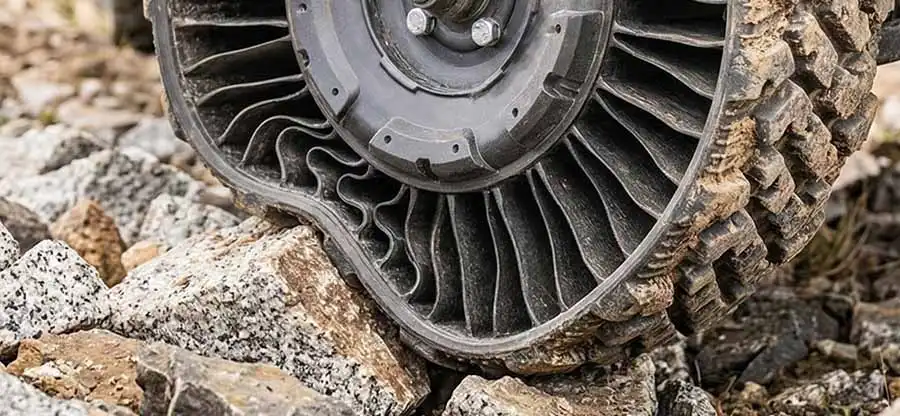
Instead of holding trapped air under high pressure, airless tires use structural geometry to support the weight of the vehicle.
An airless tire consists of three main components:
- A Rigid Inner Hub: Connects directly to the vehicle’s wheel axle just like a traditional wheel.
- A Flexible Spoke Network: A web of high-strength, flexible spokes engineered to deform under weight and spring back into shape as the wheel rotates.
- An Outer Tread Band: The replaceable rubber layer that contacts the road surface.
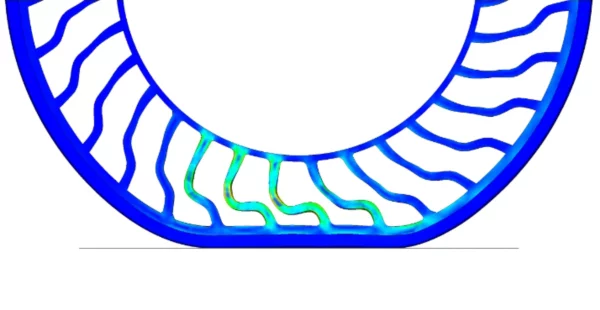
When a standard tire hits a bump, air inside the tire compresses uniformly. In an airless tire, the load is distributed across the top and sides of the spoke structure. The bottom spokes temporarily collapse under impact to absorb the shock, while the surrounding spokes carry the vehicle’s weight in tension.
Michelin’s flagship prototype, the Uptis (Unique Puncture-proof Tyre System), uses a composite material made from high-strength fiberglass resin mixed with flexible rubber. Bridgestone’s Air Free concept relies on thermoplastic resin spokes that can be recycled and remolded when the tire reaches the end of its life cycle.
Because there is no internal air pressure, an airless tire can take a direct puncture, a sidewall tear, or even lose a few spokes entirely while continuing to roll without losing structural integrity.
Why Delivery Fleets Are Leading the Shift
You won’t see airless tires on high-speed sports cars anytime soon, but you are likely to see them on last-mile delivery vans and municipal fleets.
Companies like DHL and several postal services have already begun field-testing airless tires on real delivery routes. The reasons are purely practical:
- Zero Downtime: Vans do not get sidelined by nails, glass, or curb scrapes.
- No Maintenance: Drivers and fleet managers never need to check tire pressure, calibrate sensors, or carry spare wheels.
- Predictable Tread Life: Without pressure fluctuations causing uneven center or shoulder wear, the outer tread wears down evenly across its lifespan.
- Retread Potential: Once the outer rubber wears flat, the main composite spoke structure remains intact. Fleet operators can simply bond a new tread layer onto the existing hub, drastically reducing material waste.
The Engineering Obstacles Holding Them Back
If non-pneumatic tires solve flat tires and reduce waste, why aren’t they on every car in the parking lot today?
It comes down to three main physics and manufacturing challenges:
1. Heat Buildup at Highway Speeds
Flexing composite materials under high loads creates internal friction. At low speeds (under 45 mph), this heat dissipates easily. But at highway speeds, continuous high-frequency flexing generates significant heat within the spokes, which can weaken the polymer structure over time.
2. Noise, Vibration, and Harshness
Pneumatic tires are incredible dampeners across a wide range of road surfaces. Replacing a cushion of air with solid composite spokes makes it much harder to block road noise and high-frequency vibrations from entering the car cabin. Tuning spoke geometry to be soft enough for passenger comfort without making the tire feel sluggish during cornering is a delicate balance.
3. Weight and Unsprung Mass
Current airless tire prototypes are heavier than traditional wheel-and-tire combinations. In automotive design, extra weight below the suspension (unsprung mass) makes it harder for shock absorbers to react quickly, which hurts handling responsiveness and fuel efficiency.
Where We Go From Here
Airless tire technology isn’t a silver bullet that will wipe out standard pneumatic tires overnight.
Instead, expect a gradual rollout. Low-speed electric shuttles, autonomous delivery pods, lawn equipment, and urban delivery vans are adopting the technology first because they operate in environments where downtime is expensive and speeds remain moderate.
As polymer chemistry advances and spoke geometries improve, heat dissipation and weight issues will diminish. Bridgestone and Michelin are targeting broader consumer availability toward the end of the decade, starting with passenger electric vehicles that benefit most from low-maintenance design.
Eliminating pressurized air won’t just spare you from changing a tire on the side of the road. It represents a fundamental shift toward low-maintenance, closed-loop transport where wheels last as long as the vehicle itself.