If a doctor or physical therapist wants to check how well you are walking after knee surgery or an ankle fracture, they usually ask you to do something simple: walk down a hallway while they watch.
While an experienced clinician can spot obvious limps, visual observation has a big flaw. It is subjective. It cannot tell you exactly how many kilograms of force you are putting on your recovering joint, nor can it spot micro-asymmetries in your stride timing.
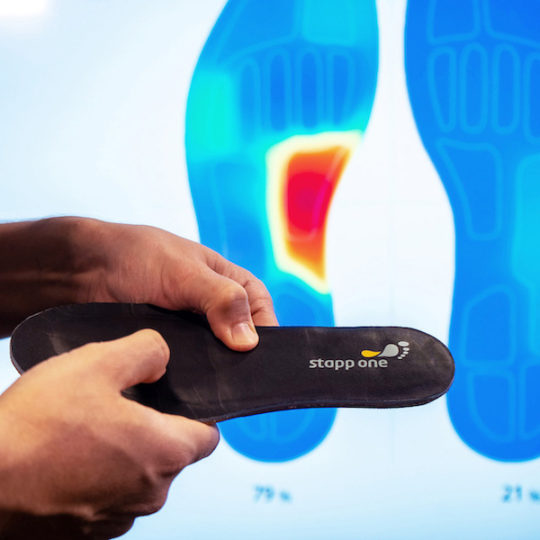
To get hard numbers, clinics used to rely on giant, expensive force plates bolted to the floor. The Austrian tech company STAPPONE took a different route: they built that force plate directly into a flexible sensor insole that slips inside a standard shoe.
Here is a closer look at the technology inside the STAPPONE platform, how its textile pressure matrix works, and why live biofeedback is changing rehabilitation.
The Hardware Challenge: Why Standard Sensors Fail in Shoes
Measuring load on a solid metal beam in an industrial factory is easy. Measuring dynamic weight inside a soft shoe while a human runs, jumps, or walks is a nightmare for hardware engineers.
If you use rigid silicon or standard thin-foil pressure sensors, the repeated bending of the shoe rapidly degrades the traces. The sensors crack, lose calibration, or stop working after a few thousand steps.
To solve this, STAPPONE developed a full-surface textile pressure sensor matrix.
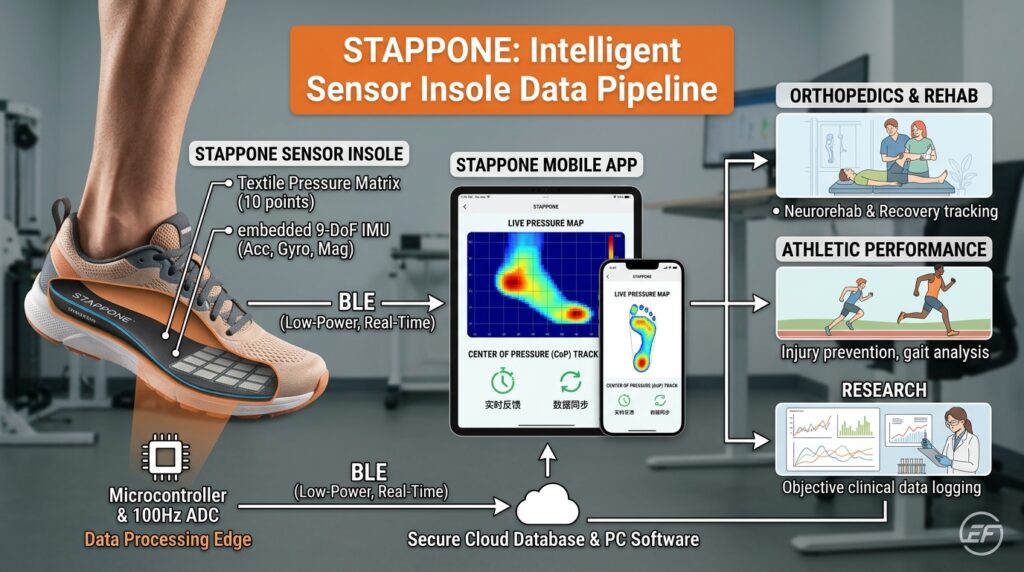
Here is what is packed inside the insole:
1. Conductive Textile Matrix
Instead of metal or foil layers, the insole uses a flexible, conductive textile structure with up to 24 individual pressure-sensing fields. Because fabric naturally flexes with the shoe, it resists mechanical fatigue and offers up to 50 times the lifespan of conventional foil sensors.
2. 9-DoF Inertial Measurement Unit (IMU)
Pressure nodes only tell you downward vertical force. To capture the full picture of a foot in motion, the insole includes a 3-axis accelerometer, gyroscope, and magnetometer. This lets the system calculate spatial parameters like stride length, foot roll angle, cadence, and contact time.
3. Onboard Power and Local Storage
Each insole contains a 370mAh battery that delivers around 36 hours of active use, along with 256 MB of local flash memory. If the Bluetooth signal drops during outdoor sprint tests or long walks, the insole buffers the raw telemetry locally so no step data gets lost.
How the Closed-Loop Telemetry Pipeline Works
Capturing high-frequency pressure data is only useful if the user or clinician can act on it immediately.
When someone walks while wearing the STAPPONE sensor insole, data flows through a four-stage real-time loop:
- Grid Sampling: The internal chip samples the pressure fields and movement vectors tens to hundreds of times per second.
- Noise Reduction: Onboard algorithms filter out small voltage spikes caused by shoe fabric wrinkling or twisting.
- BLE Transmission: The clean data stream transmits wirelessly via low-energy Bluetooth to a nearby tablet, phone, or PC.
- Instant Biofeedback: The companion software translates those signals into an easy-to-read live pressure heatmap and video feed.
If a patient recovering from an ACL tear is instructed not to exceed 20 kg of weight on their injured leg, the app provides instant visual or acoustic signals the moment they step over that limit. This direct feedback teaches the brain proper weight distribution before bad movement habits take root.
Where Live Gait Data Makes the Biggest Impact
Digitizing movement with a smart sensor insole opens up clear benefits across three major areas:
Post-Surgical Orthopedics
After hip replacements, meniscus repairs, or complex bone fractures, surgeons prescribe strict “partial weight-bearing” limits. Without objective data, patients simply guess what 30% or 50% body weight feels like. The insole gives them an exact digital target to hit.
Neurorehabilitation
Conditions like Parkinson’s disease, stroke, and multiple sclerosis often disrupt smooth gait cycles. By reviewing pressure heatmaps and stride symmetry over time, neurologists can spot subtle movement changes, adjust therapy early, and help prevent dangerous falls.
Athletic Performance and Injury Prevention
In sports, uneven loading leads to chronic overuse injuries like shin splints or tendonitis. Athletes and coaches use the insole to analyze contact phases during running, spot foot-roll imbalances, and adjust training technique to optimize speed while staying healthy.
Final Thoughts
The STAPPONE platform stands out because it prioritizes practical hardware durability. Instead of treating a smart shoe insert like a fragile prototype, they engineered a soft textile array that stands up to daily wear while yielding accurate medical data.
By replacing subjective visual checks with live pressure maps and real-time audio cues, this wearable technology turns the simple act of taking a step into actionable insight.